
There Are Only Two Real Marketing Situations
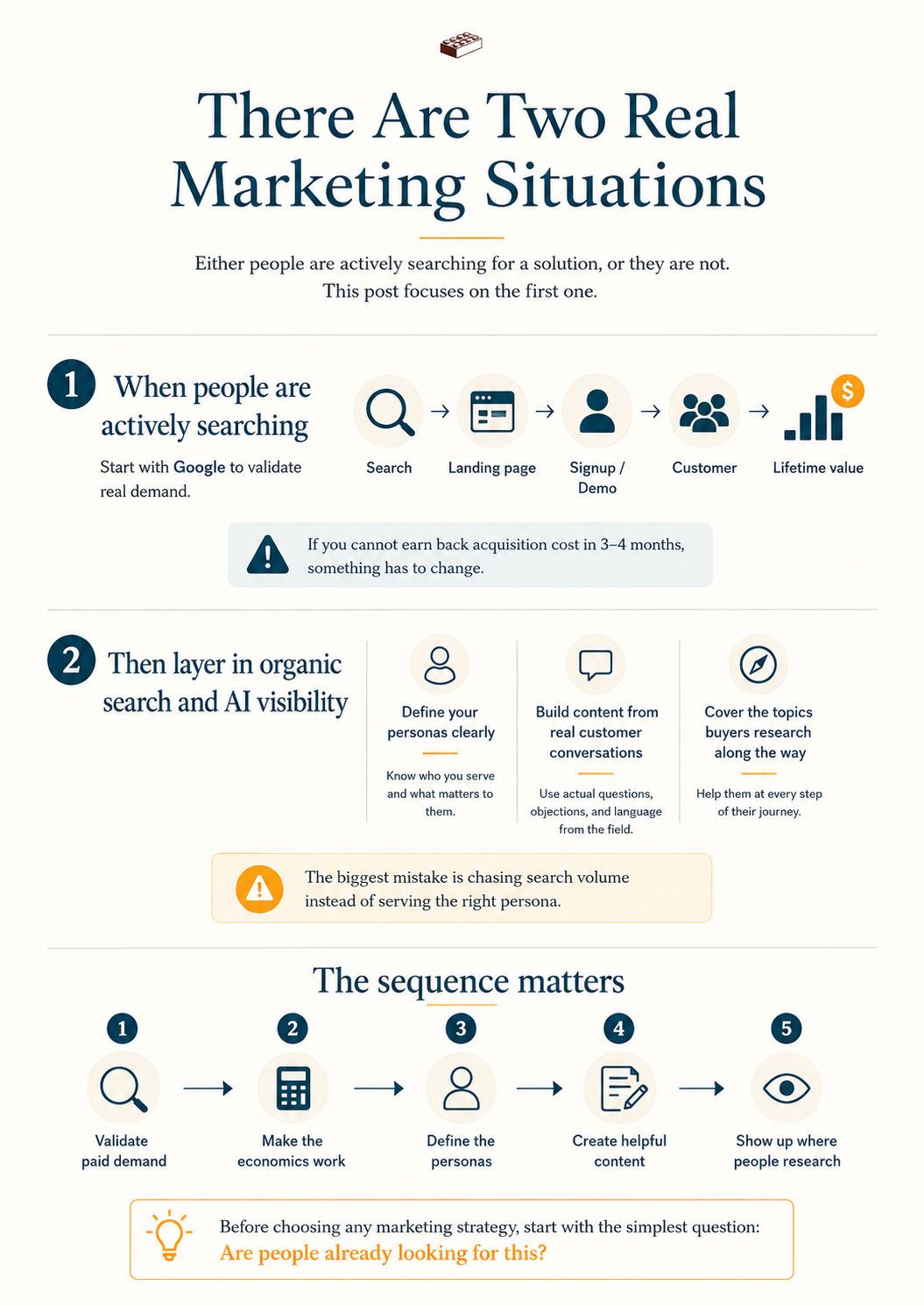
Marketing can be split into two real situations.
The first situation is when somebody is actively searching for a solution. The second situation is when they are not actively searching for a solution.
It is kind of as simple as that. Either your audience knows they want something and you are delivering that thing, or they do not know they want that thing yet.
Those two situations require completely different approaches to marketing. This post is about the first one, where there is already active demand for the thing you sell.
When People Are Searching, Start With Google
If your audience knows they want something and they are actively searching for it, I would start with Google.
I know there has been a lot of talk and hype around AI search, answer engines, and all the changes happening in search. Those changes are real, but the vast majority of active search demand still runs through Google.
Google is where people go when they know they have a problem and are trying to find a solution. That makes it the most direct place to validate whether the demand you think exists actually leads to customers.
I would start with paid search.
Not because you necessarily want to run ads forever, but because paid search gives you a much faster feedback loop. It allows you to validate who is coming through, what they are searching for, and whether the terms you are targeting actually ladder back up to the right customer for your product.
Are the people searching these terms the people you want to reach? Do they sign up? Do they request a demo? Do they become customers?
Those are the first questions you need to answer.
The Entire Funnel Has to Pencil Out
The exact funnel will depend on the price point and sales process for your product.
If you have a lower-priced, self-service product, someone might click an ad, visit a landing page, and sign up directly. If you have a higher-priced product, they might request a demo, talk with your team, and be onboarded manually.
Whatever the process looks like, you need to trace the economics all the way through.
What did it cost to generate the click? How many clicks turned into signups or demo requests? How many of those people became customers? How long did those customers stay, and what was their lifetime value?
Typically, I would want to see a path to earning back the acquisition cost within the first three or four months. If that is not happening, something has to change.
It might be the search terms. It might be the landing page. It might be the offer, the sales process, the onboarding, the pricing, or the retention.
But something is not right.
This is one of the first places where I see companies make mistakes. They assume the economics will improve over time.
They tell themselves that customers will eventually stay longer, conversion rates will eventually increase, or the ads will eventually become more efficient. Sometimes those things do happen, but you cannot build your strategy around the assumption that they will.
It is important to be stringent during these early stages because you can easily trick yourself into scaling something that is actually losing money. The funnel might be generating customers and producing some revenue, but that does not mean you are getting back what you are putting into it.
The most dangerous result is not necessarily getting zero customers. The most dangerous result can be getting just enough customers to convince yourself that the strategy works, even though the economics never will.
That creates a downward spiral. You spend more money to acquire more customers, but every new customer compounds the underlying problem.
You do not want that.
Validate the Paid Funnel First
We are still talking about the first marketing situation, where people are actively searching for a solution like yours.
When that demand exists, the first step is to validate the paid funnel. You want to know that you can reach the right people, turn those people into customers, and earn back what you spent to acquire them.
Once that funnel works, you can begin supplementing it with organic search and organic recommendations inside AI tools.
Paid search tells you what people are actually looking for and what converts. Organic content allows you to keep showing up around those same questions without paying for every individual click.
This is where the process starts to become more durable.
Define the Personas Before You Choose the Keywords
Before creating a large amount of organic content, you need to define your customer personas extremely clearly.
Who are these people? What are they searching for? Why are they searching for it? When does the problem become important enough for them to look for a solution? Where do they go for information, and how do they describe the problem?
You want to be explicit about the who, what, when, where, why, and how.
That understanding becomes the filter through which every content idea has to pass. It also gives everyone working on the content project a shared understanding of who the content is actually for.
The number one mistake I see companies make here is going after search volume instead of going after their personas.
I have experienced this on the business side when SEO consultants have come in. They open a keyword tool and show you a list of terms that supposedly represent enormous opportunities for your website.
They say, “Look at how much search volume this term has. If you ranked for it, you could get all of this traffic.”
But the first question should be, which persona does this term apply to?
I understand that a high-level definition or beginner topic might have a lot of search volume. But if none of your personas need that information because they already know what the thing is, then that traffic is not useful to you.
You are not creating content for every person who might possibly visit your website. You are creating content for the people who could realistically become good customers.
The Wrong Traffic Creates Real Problems
When you target topics that are too broad or too basic, you often attract someone who is more junior than your most junior customer persona.
That might make your traffic numbers look better. It might even increase the number of signups or demo requests you receive.
But it does not necessarily improve the business.
If you have a self-service product, those people may sign up without having the knowledge, audience, resources, or use case required to succeed. That creates more support issues, lower activation, and higher churn.
If you have a sales-led product, you may generate more demo requests without generating more sales. Your team ends up spending time talking to people who were never a good fit in the first place.
Traffic can look like growth long before it turns into actual growth.
Do not fall for the trap of chasing a term simply because it has a lot of volume. Ask which persona needs the information, what they would do after reading it, and how that action connects to the product you sell.
If you cannot answer those questions, the volume does not matter.
Build Content From Real Customer Conversations
Once you have the personas defined, the content itself should come from what you are already learning.
Take the transcripts from demos. Take conversations with customers, support tickets, interview notes, emails, and the knowledge inside your team.
Then look for the issues that continue to come up.
If customers are repeatedly struggling with a certain problem, that becomes a content piece. If they are asking about a current topic, that becomes a content piece. If they are comparing two approaches or trying to understand how something applies to their particular situation, that becomes a content piece.
You do not need to sit in a room and invent imaginary topics.
Your customers are already telling you what they need help with. The job is to capture that knowledge and translate it into something useful for the next person experiencing the same problem.
I would start by publishing at least once a week. From there, you can increase the cadence to twice a week as the process becomes more consistent.
At Interact, we currently publish five pieces a week. We are able to do that because I have a deep amount of knowledge from years of customer conversations, and we have a process for translating those conversations into content.
If you have a subject matter expert inside the business with that depth of knowledge, it makes sense to scale the content around them. The ideas are already there.
The work is extracting them, organizing them, and turning them into complete pieces.
Search Is No Longer Only About Winning the Click
The goal is still to show up in Google, but you are also creating content for answer engines and AI conversations.
Someone using an AI tool might not type in one clean search term. They may have a long, meandering conversation about the problem they are experiencing, the options they are considering, the constraints they have, and what they have already tried.
You want your content to cover as many of those relevant topics as possible.
That does not mean publishing hundreds of generic articles. It means covering the questions that matter to your actual personas with enough depth that your company continues to appear throughout the research process.
Your brand might show up when they ask about the problem. It might show up again when they compare solutions. It might show up when they ask about implementation, pricing, alternatives, or a specific use case.
Even if they do not click through every time, they continue seeing your company mentioned in the context of the problem they are trying to solve.
Eventually, the reaction becomes, “Okay, this company keeps showing up. They clearly know something about this.”
That repeated presence matters.
Search content used to be almost entirely about winning a click. Now, part of the goal is being present inside the answer, even when the person never leaves the search result or AI conversation.
The Sequence Matters
This is the approach I would use when people are already searching for a solution like yours.
Start with paid search so you can validate that the demand leads to the right customers. Make sure the economics work before you scale the spend. Define the personas clearly enough that every keyword and content idea can be tied back to a real customer.
Then take what you are learning from demos, support conversations, and customer interactions and turn that knowledge into content. Cover the relevant topics deeply enough that your company can continue showing up across Google and AI as people research the problem.
Do not start by creating hundreds of articles because a keyword tool says the topics have traffic. Do not scale an advertising funnel simply because it has produced a few customers.
Validate the demand. Validate the customer. Validate the economics.
The second marketing situation, where people are not actively searching for the solution, requires a different approach. In that situation, you have to help people recognize themselves in the problem before they are ever going to search for a product.
But before choosing any marketing strategy, start with the simplest question.
Are people already looking for this?
Everything else follows from the answer.
