
Marketing Funnels are Dead: Long Live the Marketing Funnel
I present for your consideration the dead marketing funnel. The one that was taught from 2016-Present that no longer makes economic sense. The way this has been taught is that you just need one good funnel. All the emphasis is on building the funnel, and improving the conversion rates. The people teaching this are claiming they can help you improve the conversion rates so your funnel prints money.
I will now present my case for why this doesn’t work anymore. In order for this funnel to work, you need to improve the variables. The variables are as follows.
Ad Cost (CPC)
Offer Conversion Rate
Customer Lifetime Value (LTV)
I have added the current numbers to the funnel below to show where things stand today. The 3% conversion rate for lead magnet funnels is from our internal data at Interact for people who use paid traffic into a quiz funnel. The conversion rate typically sits around 3% for paid traffic going to a quiz. That means if you are paying $0.10 per click from ads, you are paying $3.33 per lead. According to ChatGPT, the average conversion rate for an email lead into a paid offer in 2026 is also around 3%. So you have to multiply the cost again, and you get to $109 per customer.
In 2026, $109 per customer is a lot. People have pulled back on spending, consumer sentiment is low, optimism is low. If you start out in a $109 hole for every customer, I’d argue it’s hard to get your money back.
But that’s not the only thing that has changed. The 3% conversion rate into a quiz funnel, or most funnels, is lower than in previous times. People are more stingy about giving their email address than they were in the 2016-2020 period. The 3% to the paid offer is also lower. In the times of economic stimulus during the pandemic you might see 10% or 20% conversion to paid.
So if we do a thought exercise here and look at how this would change if the economic situation was different, we have a very different scenario. Let’s say traffic only costs $.05 per click, the lead magnet conversion rate is 10% and the paid offer conversion rate is 10%. So then you’d have a lead for $0.50 and a paying customer for $5. Now that funnel is excellent. But it’s not what we are seeing in 2026.
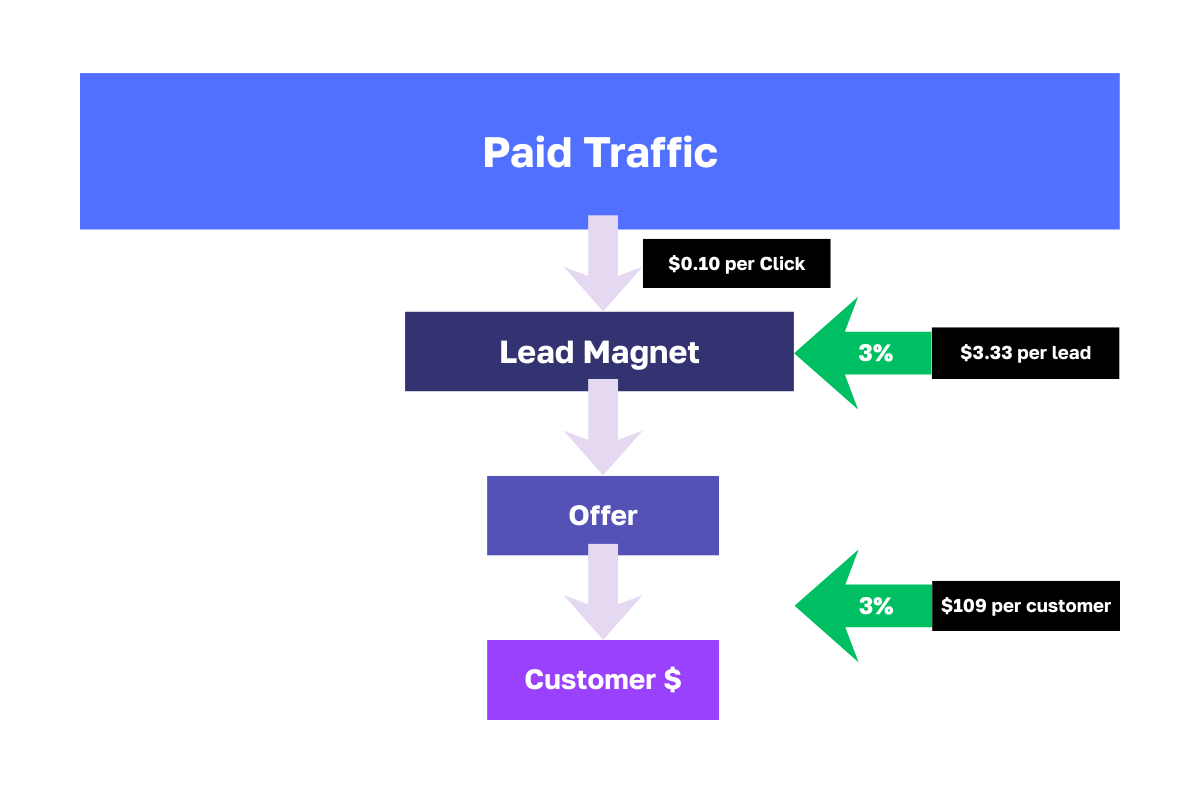
Most of the people pitching funnels try to convince you that their funnel will get you back to those better conversion rates. But that’s not what I see in reality. The only data point I have hard numbers on is the lead magnet conversion rate from paid traffic. And that is sitting at 3% despite people’s best efforts. I’ve seen customers iterate and iterate and iterate on their quiz lead magnets, only to default back to 3% and around $0.10 per click. These numbers are more a result of the cost of advertising and of consumer sentiment than of the lead magnet offer itself. Quizzes are one lead magnet. Webinars and free guides are also popular right now. And the people I talk to try all the different types of lead magnets. The opt-in variation isn’t every high. You might bump 3% to 4% but then the law of large numbers kicks in and it reverts back to the mean of around 3% over a large number.
Same thing with the paid offer strategy. There was a time when you almost couldn’t miss with a paid offer, speaking of 2018, 2019, 2020, and 2021. But then inflation kicked in. People started feeling sticker shock at the grocery store. Economic uncertainty set in, and all of a sudden the paid conversion rate began to tank in the inverse of inflation. I will admit I don’t have hard numbers on this since we don’t handle checkout on Interact, but I’ve spoken with enough people to know that generally this is the case. 3% for a paid offer from a webinar or a quiz or a guide is the general mean conversion rate.
So the marketing funnel is dead. If you are in for $109 to get a single paying customer, you’ll have a very hard time getting your money back. And most people are just losing money. That’s the reality I see on the ground in real life when I talk to people.
Except, there is a new marketing funnel that is printing money. And it’s the relational marketing funnel. Where traffic is not coming from paid, but from organic. Traffic is coming from people you’ve built para-social relationships with through your content and conversations. Here’s what it looks like.
This funnel has different elements than the old funnel.
Relationship building content
Lead Magnets
Paid Offers
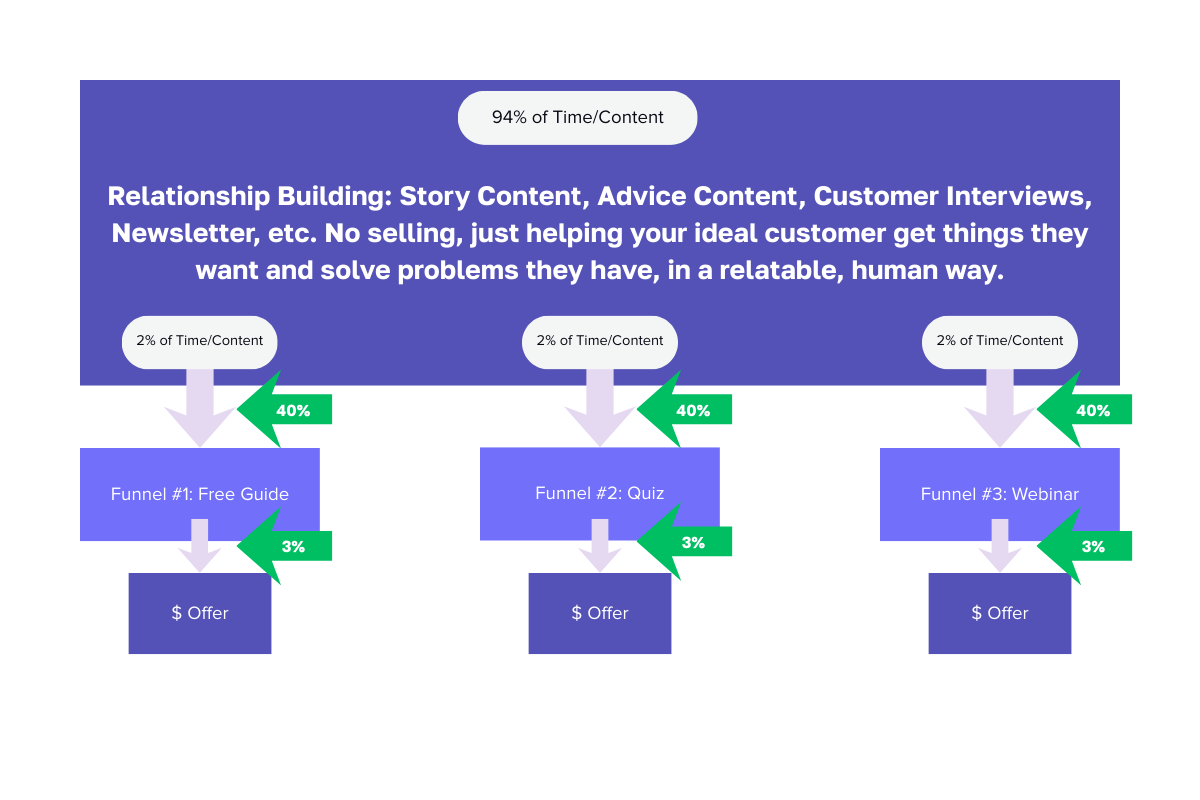
Relationship building content accounts for 94% of the activity and effort in this funnel. Meaning that 94% of the time you are creating content and talking to people with the aim of building a web of content that ties back to you as the creator. This type of content is storytelling, sharing advice, interviewing people, having fun, providing entertainment, all the things that build a relationship with your audience.
Then, when you present a lead magnet offer, whether it’s a quiz, a guide, a webinar, or something else, the conversion rate is 40%. That is hard data I do have from our customers who operate in this way. Creators who build relationships with their audience, and then send organic traffic through a lead magnet quiz, have an average conversion rate of 40%. And that’s not the average from someone who starts the quiz, that the average from someone who views the quiz, which is 2.2x higher than the overall average conversion rate of quizzes on the interact platform, and a whole heck of a lot higher than the 3% that’s coming from paid traffic.
So I present for your consideration the relationship marketing funnel. Where you spend almost all of your time creating content and talking to ideal customers to build a connection to your audience. Then you present lead magnets that funnel into paid offers on occasion. But when you do present those offers, the opt-in rate is way higher, and you are not paying for the traffic. So you have a nicely profitable business. And the marketing funnel is back. Just adapted for 2026.
If you want my economic interpretation of why this relationship marketing funnel works. I think it’s because so many people got burned by the old model. They bought stuff they didn’t need. They purchased courses they never used. They spent money on things that didn’t deliver value. So now the buyer is skeptical. They want to wait and see for a while. They want you to prove that you’re a genuine person. And the best way to do that is to follow you for a while. Anyone can fake it for an ad that touts great success and riches. But it’s a lot harder to fake it over a long period of time. So if someone follows you for 6 months, a year, 2 years, and you stay consistent with what you are saying, you stay consistent with what you are advising, then they build trust with you. Then, when you present your lead magnet and ultimately your paid offer, they are already decided that they know you and trust you, and if that particular lead magnet and offer matches what they need, they will opt in and buy it.
